

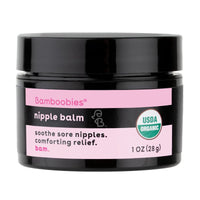
Bamboobies organic nipple balm for soothing skin - 1 oz
Regular price
$9.99
Clicking the button above supports our work. As an Amazon Associate, we earn a small commission on qualifying purchases at no extra cost to you. We only recommend products we believe in.
At a Glance
No, you do not need to wash this off before a feed. All five ingredients are food-grade and organic: sunflower seed oil, olive oil, beeswax, shea butter and calendula. Apply after nursing and leave it. It is lanolin free, fragrance free, USDA Organic, and comes in a 1 oz jar. Worth knowing before you buy: the Cochrane review of nipple pain treatments found insufficient evidence that any cream, lanolin included, beats applying nothing, and pain typically settles to mild by seven to ten days regardless. A balm reduces friction and stops skin re-splitting while the real cause is fixed, and the real cause is almost always the latch. It contains beeswax, so it is not vegan, and the oils will mark fabric.
You are dreading the next feed. Not the tiredness, not the night, just the first ten seconds of it, and you have started counting the hours between. Nobody warned you that this was the part that would make you consider giving up. It usually is fixable, and it usually is not the cream that fixes it.
Description
This organic nipple balm has five ingredients, all of them certified organic: sunflower seed oil, olive oil, beeswax, shea butter and calendula. That is the whole list. No lanolin, no parabens, no petroleum, no synthetic fragrance. One 1 oz (28 g) jar, small enough to live in a nursing basket.
The question most people arrive with: no, you do not need to wipe it off before a feed. Everything in it is food-grade and safe for your baby to ingest, which is the practical advantage of a short plant-oil formula. Apply after nursing and leave it. Not having to clean a cracked nipple with a cloth before every feed is worth more at 3am than any ingredient on the label.
Now the part a product page does not usually tell you. The Cochrane review of treatments for painful nipples looked at four trials and 656 women across lanolin, glycerine pads, breast shells, expressed breast milk and all-purpose ointment. It found insufficient evidence that any of them relieved nipple pain better than applying nothing at all. It also found that whatever women used, pain settled to mild levels by roughly seven to ten days after birth.
So we are not going to tell you a balm heals cracked nipples. What it does is reduce friction and keep skin from drying and re-splitting while the actual cause gets fixed, and the actual cause is almost always the latch. That is a real job, and it is comfort rather than cure. Mindy's note below is about the part that does the healing.
What makes this one a sensible choice if you are going to use a balm. It is lanolin free, which matters if wool makes your skin react, and lanolin has no evidence advantage to give up. It is USDA Organic. It has no fragrance to irritate skin that is already broken. And the ingredient list is short enough to read in one breath, which in a product going on broken skin next to a newborn's mouth is the whole point.
Two honest notes. It contains beeswax, so it is not vegan. And the natural oils can stain clothing and bras — nursing pads solve it, and this is the one reason to keep a pack on hand rather than a nice-to-have.
Why women love it
- Five organic ingredients: sunflower oil, olive oil, beeswax, shea butter, calendula, and nothing else
- No need to wash off: everything in it is safe for your baby to swallow, so you apply it and leave it
- Lanolin free: the alternative if wool sensitivity is a problem, with no evidence trade-off
- No fragrance, parabens or petroleum: nothing added to irritate skin that is already cracked
- USDA Organic and not tested on animals
- A balm, not a runny cream: it stays where you put it, which matters under a bra
- Small jar, low price: a 1 oz pot that lasts through the weeks you actually need it
Best for
- The first two weeks, when nipples are tender and the latch is still being learned
- Anyone who reacts to lanolin or would rather not use a wool derivative
- Women who want a short, readable ingredient list on something their baby will taste
- Keeping in a hospital bag or nursing basket — the jar is under two inches
- Not vegan. It contains beeswax
- Not a treatment for the cause. If pain is worsening or lasts beyond two weeks, a balm is not the answer
- It will mark fabric. Plan on nursing pads
Related reading
Mindy's guide to managing breastfeeding pain and discomfort is the piece to read alongside this, because it covers the causes rather than the creams. If pain comes with a lump, redness or feeling unwell, her guide to postpartum mastitis explains what to do and how current guidance has changed. And breastfeeding must-haves covers what is genuinely worth having in the first weeks.
Explore more
This sits in our nursing and nipple care collection, curated by Mindy Motta, FNP-C, inside the wider breastfeeding and lactation range and our postpartum essentials. Because the oils mark fabric, Lansinoh nursing pads are the practical companion. If a balm is not touching it, silver nursing cups work by a different mechanism, protecting the nipple from rubbing between feeds.
A quiet companion for the wait
The early weeks of feeding are mostly endured rather than enjoyed, usually in the dark. Our affirmation candles were made for that stretch of the night.
A note from Mindy on what actually heals sore nipples
As a nurse practitioner in OB-GYN, here is the thing I would say before you spend anything: a balm is comfort, and the latch is the cure.
The most common cause of cracked, painful nipples is a shallow latch — not enough breast tissue in the baby's mouth, so the friction lands on the nipple tip instead of being spread across the areola. No cream fixes that. Correct the latch and the skin starts healing on its own, which is exactly why the Cochrane review found ointments performing no better than nothing.
Normal is tenderness in the first few seconds of a feed that eases as the feed goes on, settling over the first week or two. That is the pattern to expect.
These are not that, and each points somewhere specific:
- Pain through the entire feed, or pain that is getting worse rather than better. That is a latch problem that needs eyes on it, not more balm
- A misshapen nipple after a feed, wedge-shaped or creased like a new lipstick, is the clearest sign of a shallow latch there is
- Burning, itching or shooting pain that continues between feeds, often with shiny or flaky skin, can be thrush, which needs treating in you and the baby together
- A heart-shaped tongue tip, or a baby who cannot stay latched, may be a tongue tie and needs assessing
- Cracks that will not close, or any spreading redness, swelling or fever. That is a reason to be seen, not to wait
Two weeks is my rule. If you have had help with positioning and it still hurts after two weeks, stop troubleshooting alone and see an IBCLC, a board-certified lactation consultant. Nipple pain is the single most common reason women stop breastfeeding before they wanted to, and it is usually fixable by someone watching one feed. A jar of balm costs ten dollars and an hour with an IBCLC costs a great deal more, but only one of them addresses the reason it hurts.
One more, quietly: expressed breast milk works about as well as any cream, and it is free. A few drops rubbed in after a feed is a reasonable first thing to try before buying anything.
Mindy Motta, FNP-C
FAQs
Do I need to wash nipple balm off before breastfeeding?
Not this one. All five ingredients are food-grade plant oils, butters and beeswax, and the brand states it is safe for your baby to ingest. Apply after a feed and leave it. Avoiding a wipe-down on cracked skin before every feed is a genuine comfort advantage.
Does nipple cream actually work?
Less than the marketing suggests. A Cochrane review of four trials and 656 women found insufficient evidence that lanolin, glycerine pads, breast shells, expressed breast milk or all-purpose ointment relieved nipple pain better than applying nothing. What a balm does well is reduce friction and stop skin drying and re-splitting while the underlying cause is corrected. Treat it as comfort, not as treatment.
What is the difference between lanolin and lanolin-free balms?
Lanolin is derived from wool and is the traditional choice. Lanolin-free balms like this use plant oils and butters instead. The evidence does not favour either for pain relief, so the deciding factors are practical: whether you react to wool, whether you want a vegan-adjacent formula, and texture preference.
Is it safe for my baby to swallow?
Yes. Sunflower oil, olive oil, beeswax, shea butter and calendula are all food-safe, and no washing off is required. If your baby develops a rash around the mouth after you start using anything new, stop and mention it to your provider.
Will it stain my bras and clothes?
It can. Natural oils mark fabric, and this is the most common complaint about plant-oil balms. Nursing pads solve it, and are worth having anyway in the early weeks.
Is it vegan?
No. It contains beeswax. It is free of lanolin, parabens, petroleum and synthetic fragrance, and is not tested on animals, but beeswax makes it unsuitable if you avoid all animal products.
Is shea butter safe if I have a tree nut allergy?
Shea is technically a tree nut but shea butter is highly refined and contains very little of the protein that causes allergic reactions, and reactions to it are rare. If you have a severe tree nut allergy, check with your provider before using it on skin your baby will feed from.
How long should sore nipples last?
Tenderness in the first days is common and, in the Cochrane data, pain settled to mild levels by around seven to ten days after birth regardless of what was applied. Pain that lasts beyond two weeks, or that worsens rather than eases, is not part of the normal pattern and is worth having looked at.
When should I see a lactation consultant?
If pain lasts through the whole feed rather than easing after the first few seconds, if your nipple comes out creased or wedge-shaped, if there is burning or shooting pain between feeds, or if you have had help with the latch and it still hurts after two weeks. An IBCLC watching a single feed fixes most of this.


Bamboobies organic nipple balm for soothing skin - 1 oz
Regular price
$9.99
Bamboobies
Bamboobies organic nipple balm for soothing skin - 1 oz