


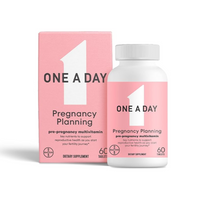
One A Day Pregnancy Planning multivitamin - 60 tablets
Regular price
$20.99
Clicking the button above supports our work. As an Amazon Associate, we earn a small commission on qualifying purchases at no extra cost to you. We only recommend products we believe in.
At a Glance
A preconception multivitamin with folate delivered as both folic acid and methylfolate, plus zinc, B12 and vitamin D, at 60 tablets. The dual-folate design is a reasonable hedge and covers you whether or not you carry an MTHFR variant. It is not a full prenatal: no iron, no DHA. ACOG still recommends folic acid as the standard, and starting something at least one month before conception matters far more than which form you pick.
Someone in a forum told you that you might have the MTHFR gene and that ordinary folic acid won't work for you. Now there's a $21 bottle in front of you promising to solve a problem you're not sure you have.
Description
This pregnancy planning vitamin from One A Day is a preconception multivitamin built around folate delivered in two forms at once, folic acid and methylfolate, alongside zinc, vitamin B12 and vitamin D. Sixty tablets, one a day, roughly a two-month supply. It is designed for the window before conception rather than for pregnancy itself.
The dual-folate approach is the reason to consider it, and it's worth understanding properly rather than through the version circulating on fertility forums.
Folic acid is synthetic folate. Your body converts it to the active form, 5-MTHF, using an enzyme called MTHFR. A common variation in the MTHFR gene makes that conversion less efficient, and depending on the variant and population, a substantial share of people carry one. Methylfolate skips the conversion because it is already in the active form.
Here is the part the marketing usually leaves out. ACOG still recommends 400 mcg of folic acid daily for anyone who could become pregnant, including people with MTHFR variants. Folic acid is the form used in the trials that established neural tube defect prevention, which is a genuinely strong body of evidence. A 2024 study found methylfolate was about as effective as folic acid at maintaining folate levels in pregnancy, with the added feature of not producing unmetabolized folic acid in circulation. Some national bodies, including the Polish obstetrics society in 2023, now recommend both forms together. That is precisely what this product does.
So the fair summary is: taking both is a sensible hedge, not a breakthrough. It costs about the same as a single-form product and removes a decision you don't have enough information to make, since most people have never been tested for MTHFR and generally don't need to be. What it isn't is a reason to delay. Whichever form you take, take something.
One thing to be clear about: this is not a full prenatal. There's no iron and no DHA. That is a defensible choice for the preconception window, where iron needs haven't risen yet, but it means switching products at a positive test rather than continuing this one.
Why women love it
- Both folic acid and methylfolate: covers the MTHFR question without needing a test first
- One small tablet daily: easier to stick with than large softgels or multi-pill regimens
- Zinc, B12 and vitamin D: the micronutrients most relevant before conception
- Around $21 for 60 days: roughly 35 cents a day, cheaper than most preconception formulas
- No iron: which for many people means no constipation and no nausea, the two reasons prenatals get abandoned
- Widely stocked: easy to reorder without a subscription
Best for
- Women starting to think about conceiving in the next few months to a year
- Anyone who has read about MTHFR and wants the question covered without testing
- People who stopped taking a prenatal because the iron made them nauseated
- Those who want a simple, inexpensive starting point rather than a premium formula
- Not a substitute for a prenatal once you're pregnant. No iron, no DHA
- Not enough on its own if you have known anemia, a restrictive diet, or a prior neural tube defect pregnancy, where higher-dose folic acid is usually prescribed
Related reading
Mindy's guide to what actually matters in a prenatal for getting pregnant is the piece to read alongside this one, because it addresses the question underneath the whole category: prenatals are not fertility drugs. Her guide to preparing your body for pregnancy covers the three months before trying, and how to choose a prenatal walks through what changes once you're actually pregnant.
Explore more
This vitamin sits in our fertility essentials for TTC collection, curated by Mindy Motta, FNP-C. If your partner is preparing too, the One A Day pre-pregnancy couple's pack covers both of you. For the egg quality side rather than the baseline nutrition side, the egg quality supplements collection adds CoQ10 and inositol options.
A quiet companion for the wait
A daily vitamin is a small act of preparing. It doesn't fill the evenings. Our fertility affirmation candles were made for that part.
A note from Mindy on MTHFR and the folate question
MTHFR comes up in my exam room more than almost any other supplement topic, usually after someone has read a thread that scared them. So let me put it in proportion.
MTHFR variants are common, and for most people they are not a crisis. Carrying one means you convert folic acid less efficiently, not that you can't. The overwhelming majority of people with these variants take ordinary folic acid, absorb enough folate, and have healthy pregnancies. This is a matter of efficiency, not of a switch being off.
ACOG's recommendation is still 400 mcg of folic acid daily for anyone capable of becoming pregnant, and they haven't changed it despite the research on methylfolate. That's not institutional stubbornness. Folic acid is the form behind the evidence that neural tube defects drop sharply with supplementation, and that evidence is one of the clearest things we have in prenatal medicine. Methylfolate looks equally good at maintaining folate levels in more recent work, which is why I'm comfortable with either.
A product with both is a reasonable way to stop thinking about it. That is genuinely the main argument for this one. Most people have never been tested, routine testing isn't recommended, and covering both forms costs no more.
What I care about far more than the form is the timing. The neural tube closes in the first three to four weeks after conception, usually before a missed period and often before anyone knows. Start at least one month before you're trying, ideally three. A person taking plain folic acid who started in January is in better shape than a person taking premium methylfolate who starts the week she gets a positive test.
Two exceptions where the standard dose isn't the right dose. If you've had a pregnancy affected by a neural tube defect, guidance is a much higher dose of folic acid, prescribed rather than chosen off a shelf. And if you take certain anti-seizure medications or methotrexate, your folate needs are a conversation with your prescriber. Neither is a situation to manage from a product page.
Last thing. This has no iron, and that's fine before conception but not after. Have a full prenatal ready so the switch happens the day the test is positive rather than the week you get around to ordering one.
— Mindy Motta, FNP-C
FAQs
What's the difference between folic acid and methylfolate?
Folic acid is the synthetic form, and your body converts it to the active form, 5-MTHF, using the MTHFR enzyme. Methylfolate is already in that active form, so no conversion is needed. Folic acid is the form used in the trials that established neural tube defect prevention. A 2024 study found methylfolate about as effective at maintaining folate levels in pregnancy, without producing unmetabolized folic acid. Both work for most people.
Do I need methylfolate if I have the MTHFR gene variant?
Not necessarily. MTHFR variants reduce conversion efficiency rather than blocking it, and most people carrying one absorb enough folate from ordinary folic acid. ACOG continues to recommend 400 mcg of folic acid daily for anyone who could become pregnant, including people with MTHFR variants. A product containing both forms, like this one, sidesteps the question without requiring a test.
Should I get tested for MTHFR before trying to conceive?
Routine MTHFR testing isn't recommended for people planning a pregnancy, because the result rarely changes what's advised: take folate, start early enough. Testing is generally reserved for specific clinical situations rather than used as a preconception screen. If you're worried, that's a good conversation to have at a preconception visit rather than a reason to order a test yourself.
Is this a prenatal vitamin?
Not a complete one. It covers folate, zinc, B12 and vitamin D, which are the priorities before conception, but it has no iron and no DHA. Iron needs rise substantially during pregnancy and DHA supports fetal brain development, so plan to switch to a full prenatal at a positive test rather than continuing with this.
When should I start taking a pregnancy planning vitamin?
At least one month before you start trying, and three months is better. The neural tube closes three to four weeks after conception, often before a missed period, so folate needs to already be on board rather than started at a positive test. If you're reading this and haven't started, starting today is the right answer.
Will it help me get pregnant faster?
No, and it's worth being direct about that. Preconception vitamins reduce the risk of certain birth defects and correct nutritional gaps. They aren't fertility treatments and don't improve conception rates in people who are already well nourished. If you've been trying for twelve months, or six if you're over 35, that's the point to see a provider rather than to change vitamins.
Can I take this with other supplements?
Usually, but check for overlap on zinc, B12 and vitamin D, since stacking multiple products can push you well past intended amounts. If you're also taking a preconception formula containing herbs like vitex or ashwagandha, that's the more important thing to raise with your provider. Bring every bottle to your appointment rather than a list from memory.
Is One A Day really the number one OB/GYN-recommended brand?
That's the manufacturer's claim, based on their own surveys of physicians, and it's the kind of marketing line worth reading as marketing. It says something about brand familiarity rather than about formulation quality. Judge this product on what's in it, which is a reasonable and inexpensive preconception formula, rather than on the badge.


One A Day Pregnancy Planning multivitamin - 60 tablets
Regular price
$20.99
ONE A DAY
One A Day Pregnancy Planning multivitamin - 60 tablets