


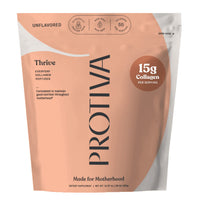
Pregnancy Safe Collagen Powder, Protiva Thrive, 16oz
Regular price
$33.99
Clicking the button above supports our work. As an Amazon Associate, we earn a small commission on qualifying purchases at no extra cost to you. We only recommend products we believe in.
At a Glance
Yes, collagen is generally considered safe while breastfeeding and during pregnancy, because hydrolyzed collagen is food protein. Your body digests it into amino acids the same way it digests chicken or eggs, and there is no known mechanism by which it would harm milk supply or a baby. Protiva Thrive is about as simple as this category gets: 15 g of hydrolyzed porcine collagen and 60 mg of vitamin C per scoop, 30 scoops per bag, and nothing else in it. Unflavored, dissolves in hot or room-temperature liquids. Two things to know before you buy. Collagen is an incomplete protein, missing tryptophan, so it adds to your protein intake but does not replace a complete source or your prenatal. And Protiva's headline claim of being clinically proven rests on one small open-label study, which is a weaker thing than it sounds.
You already know your body is being asked for more than usual, and you have started reading labels the way you never used to. The question underneath the search is not really whether collagen works. It is whether it is one more thing you have to worry about. It isn't. Here is the honest version, including the parts the tub does not tell you.
Description
This pregnancy safe collagen powder from Protiva contains two ingredients: 15 g of hydrolyzed porcine collagen and 60 mg of vitamin C per scoop. One bag holds 16 oz (450 g), which is 30 scoops, and each serving is 55 calories. It is unflavored and dissolves in hot or room-temperature liquids, so coffee and tea work as well as a smoothie. Non-GMO, and free from soy, lactose, gluten, dairy, caffeine, preservatives, additives and artificial colors or flavors.
Shopping Prime Big Deal Days, October 6–7? The sale prices are for Prime members only. Not a member? Start a free 30-day Prime trial (if eligible) before the sale. Expecting? Prime is also what unlocks the free Amazon Baby Registry Welcome Box. Is Prime worth it for new parents?
The safety question is the one most people arrive with, so here it is first. Hydrolyzed collagen is protein that has already been broken down into short peptides. Your body digests it the way it digests any other protein, into amino acids, and there is no known mechanism by which those amino acids would reduce milk supply or reach a baby in a form that could cause harm. That is why collagen is generally considered safe during pregnancy and breastfeeding. It is also why no supplement in this category has a large safety trial behind it: nobody runs one on a food protein.
What collagen is not is a complete protein. It has no tryptophan, so it cannot be the only protein you rely on. Protein needs rise meaningfully in pregnancy and stay high while breastfeeding, and 15 g is a real contribution to that. It just has to sit on top of complete protein from food, not in place of it.
The vitamin C is not decoration. Vitamin C is a required cofactor in your body's own collagen synthesis, which makes it a sensible thing to pair with collagen peptides. At 60 mg it covers 67% of the general daily value, and the pregnancy and lactation targets are higher than that, so treat it as a top-up alongside your prenatal rather than a reason to skip one.
Two ingredients is the strongest thing about this product, and it deserves saying plainly. Supplements are not approved before they go on sale, so every additive is one more thing taken daily for months on trust. There is nothing here to trust except collagen and ascorbic acid.
One gap worth knowing: the label carries no third-party certification. No NSF, no USP, no independent verification that the panel is accurate. That is normal for the category and not a red flag on its own, but it is a genuine difference from products that do carry a seal, and it is not something the packaging draws attention to.
The source is porcine rather than bovine or marine, which matters practically: this is not suitable if you avoid pork for religious or dietary reasons. Protiva's marketing argues porcine is superior because it is "a 98% DNA match to humans." Skip that claim. Hydrolyzed collagen contains no DNA at all; it is protein cut into peptides. The source affects amino acid profile marginally and dietary suitability enormously, and nothing else.
Why women love it
- 15 g of collagen per scoop: at the upper end of what published trials have used, in a single unflavored scoop
- Two ingredients, nothing else: hydrolyzed collagen and vitamin C, with no fillers, sweeteners, flavoring or carriers
- Vitamin C included: 60 mg, a cofactor your body needs for its own collagen synthesis
- Genuinely unflavored: dissolves into hot or room-temperature liquids, so coffee works and you are not tied to smoothies
- Free from the usual triggers: non-GMO, no soy, lactose, gluten, dairy or caffeine
- Simple math: 30 servings a bag, one scoop a day
- Formulated and studied in a maternal population, which is rare in this category even when the study is a small one
Best for
- Women who want to know collagen is safe while breastfeeding before they buy, and want the reasoning rather than a reassurance
- Anyone adding protein during pregnancy or postpartum who wants a version with no additives
- People who drink hot coffee or tea and want something that dissolves in it
- Those who would rather have two ingredients than a long blend
- Not a prenatal, and not a replacement for one. No folate, iron, iodine, choline, DHA or B12
- Not a complete protein. No tryptophan, so it adds to your intake rather than covering it
- Not suitable if you avoid pork. The collagen is porcine
- Not third-party certified. If an independent seal is your bar, this does not clear it
Related reading
If you are weighing collagen against everything else, our guide to collagen in pregnancy covers where it fits and what to look for on a label. Protein is the bigger question underneath it, and Mindy's pregnancy diet plan by trimester works through how much you actually need and where it comes from. For the recovery side, her guide to C-section scar care is the honest account of what helps tissue heal after birth and what only claims to.
Explore more
This powder belongs in our postnatal nutrition collection, curated by Mindy Motta, FNP-C, alongside postnatal vitamins and protein for the breastfeeding months, and in pregnancy essentials for every trimester for the months before. The wider postpartum essentials for recovery and breastfeeding collection covers the rest of the fourth trimester. If porcine is the sticking point, the Needed collagen protein powder is grass-fed bovine and built for the same window, at a higher price per serving.
A quiet companion for the wait
A scoop in the morning coffee is a small act of taking care of yourself on a day that will not offer many others. Our affirmation candles were made for the same reason, for the end of the day rather than the start of it.
A note from Mindy on what "clinically proven" means here
As a nurse practitioner in OB-GYN, this is the part I would want you to read before you decide, because the claim on the front of this product is the claim I get asked about.
Protiva really does have a published study. It is much smaller than the marketing suggests. It ran in the Journal of Pregnancy and Child Health in 2016. It was open label, meaning nobody was blinded, and not randomized — the comparison group was patients who simply did not take it. It measured serum protein, wound healing, and scores on a quality-of-life questionnaire. Those are reasonable things to measure. They are not "proven safe and effective for you and your baby," which is a claim about fetal outcomes that this study did not test.
Two more details matter. The journal is published by OMICS, and in 2019 a federal court entered a $50.1 million judgment against OMICS in the FTC's favour over how it represented its peer review. And the study protocol was twice daily, using Protiva's drink products, while this tub directs one scoop of powder. So the study is not quite testing what you would be taking, at not quite the amount you would take.
Here is what I would rather you rested the decision on. Collagen is food protein. That, not a small study, is why it is reasonable during pregnancy and breastfeeding, and it is a sturdier reason than any trial this category is likely to produce. You do not need a study to justify eating protein.
Where I would push back is stretch marks. The Cochrane review of preparations for preventing stretch marks looked at six trials and 800 women and found no high-quality evidence that any of them work. Oral collagen has been studied less than the creams in that review, not more. Whether you get stretch marks is mostly genetics and how fast your skin stretches. If a product's promise is that it will prevent them, that promise is being made ahead of the evidence, and I would rather you bought this for the protein and treated anything else as a bonus you were not counting on.
One practical note. If you are managing gestational diabetes, nausea that limits what you can keep down, or a restricted diet, protein is worth a real conversation with your provider rather than a supplement decision made alone. Fifteen grams is a meaningful amount, and it should be counted, not added on top of a plan you have already been given.
— Mindy Motta, FNP-C
FAQs
Can a breastfeeding mother take collagen supplements?
Yes. Hydrolyzed collagen is protein that has been broken into peptides, and your body digests it into amino acids exactly as it does the protein in food. There is no known mechanism by which it would reduce milk supply or affect a baby. As with any supplement while nursing, a product with a short ingredient list is the easier one to be confident about, and this one has two ingredients.
Is collagen safe during pregnancy?
Collagen itself is generally considered safe in pregnancy for the same reason it is in breastfeeding: it is food protein. The caution in this category is not the collagen, it is what else is in the tub. Sweeteners, botanical blends and unlisted additives are the things worth checking a label for. Tell your provider what you are taking, as you would with anything else.
Does collagen pass into breast milk?
Not as collagen. Protein is broken down in digestion into amino acids, which enter your bloodstream and contribute to the pool your body draws on, including for making milk. That is the same thing that happens when you eat chicken, fish or eggs. There is no collagen-specific pathway into milk to be concerned about.
Does collagen prevent or reduce stretch marks?
The evidence does not support it. A Cochrane review of six trials and 800 women found no high-quality evidence that topical preparations prevent stretch marks in pregnancy, and oral collagen has been studied less than those creams. Stretch marks are driven largely by genetics and the speed of skin stretching. Buy this for the protein.
Is 15 grams the right amount of collagen per day?
It is a reasonable amount and sits at the upper end of what published trials have used, which typically range from about 2.5 g to 15 g. Protiva's packaging goes further and says more than 15 g is "too much for your body to use." There is no established ceiling of that kind. Treat 15 g as a sensible serving, not a scientifically fixed dose.
Is porcine collagen better than bovine?
No, and the reason usually given for it is wrong. The claim that porcine is a "98% DNA match to humans" does not apply to a supplement: hydrolyzed collagen contains no DNA, only peptides and amino acids. Porcine and bovine collagen have very similar amino acid profiles. What the source genuinely decides is whether the product suits your diet, and porcine rules it out if you avoid pork.
Does this replace my prenatal vitamin?
No. There is no folate, iron, iodine, choline, DHA or B12 in it. It contains collagen and 60 mg of vitamin C, which is a partial contribution to a requirement that rises in pregnancy and lactation. This sits alongside a prenatal, never instead of one.
How long before I notice anything?
For skin and nails, studies outside pregnancy generally run eight to twelve weeks before measuring, so one 30-serving bag is roughly the shortest honest trial. For protein intake, the benefit is immediate in the sense that it counts toward your daily total from the first scoop. If your reason for taking it is postpartum hair shedding, be aware that shedding is hormonal and usually resolves on its own timeline regardless of what you take.


Pregnancy Safe Collagen Powder, Protiva Thrive, 16oz
Regular price
$33.99

PROTIVA
Pregnancy Safe Collagen Powder, Protiva Thrive, 16oz